
This is Salmon Evolution
Operations
Norway
Net biomass growth amounted to 1,592 tonnes LW in Q4, up 5 % y/y. Overall Q4 biomass production was affected by high fish logistics activity due to biomass optimization going into 2026, with underlying biomass growth in line with previous quarters. At the end of the quarter the standing biomass totaled 3,119 tonnes LW, slightly above run-rate targets. The biomass composition remained favorable throughout the quarter, with a good spread in the biomass across different weight categories leaving Salmon Evolution well positioned for 2026.
In the grow-out facility at Indre Harøy operations remained stable. Biomass growth was affected by activities to optimize the biomass going into 2026, aligned with the strategic focus to prioritize 2026 in anticipation of a strong salmon market. Biological KPIs remained good through Q4, highlighted by a continued low mortality with a last twelve-month average of ~3%.
To ensure continued steady increase in biomass production at Indre Harøy, Salmon Evolution have several ongoing workstreams centered around increasing tank utilization, optimization of water quality and operational tuning across different disciplines. In coming periods this is expected to result in continued steady progress on key parameters.
Results at the Dale smolt facility continue to outperform last year, with biomass growth above Q4 last year, driven by good water temperatures as well as a result of the corrective measures taken in 2024 to improve smolt quality, including investments in upgrades to the facility. During 2025 all smolt deliveries have been above targeted stocking weights.
Harvest for the quarter ended at 1,203 tonnes HOG, down from 1 729 tonnes HOG the same period last year. A lower harvest volume y/y reflects the aforementioned focus on 2026, with record biomass levels going into the new year. Average harvest weights in the quarter ended at 3.3 kg HOG with a superior grade share of 92 %.
Due to overcapacity, ~69 tonnes LW of smolt was sold from Dale smolt facility to a well renowned sea-based salmon farmer in Q4. The sale was done at regular market terms generating revenues of approximately 8.3 NOKm.
Harvest guidance: Salmon Evolution has a 2026 harvest guidance of 7,000 tonnes HOG. Continued production growth in phase 1, paired with ramping up phase 2, adds significant production capacity through 2026. The effect of the phase 2 ramp up on harvest volumes in 2026 is limited.
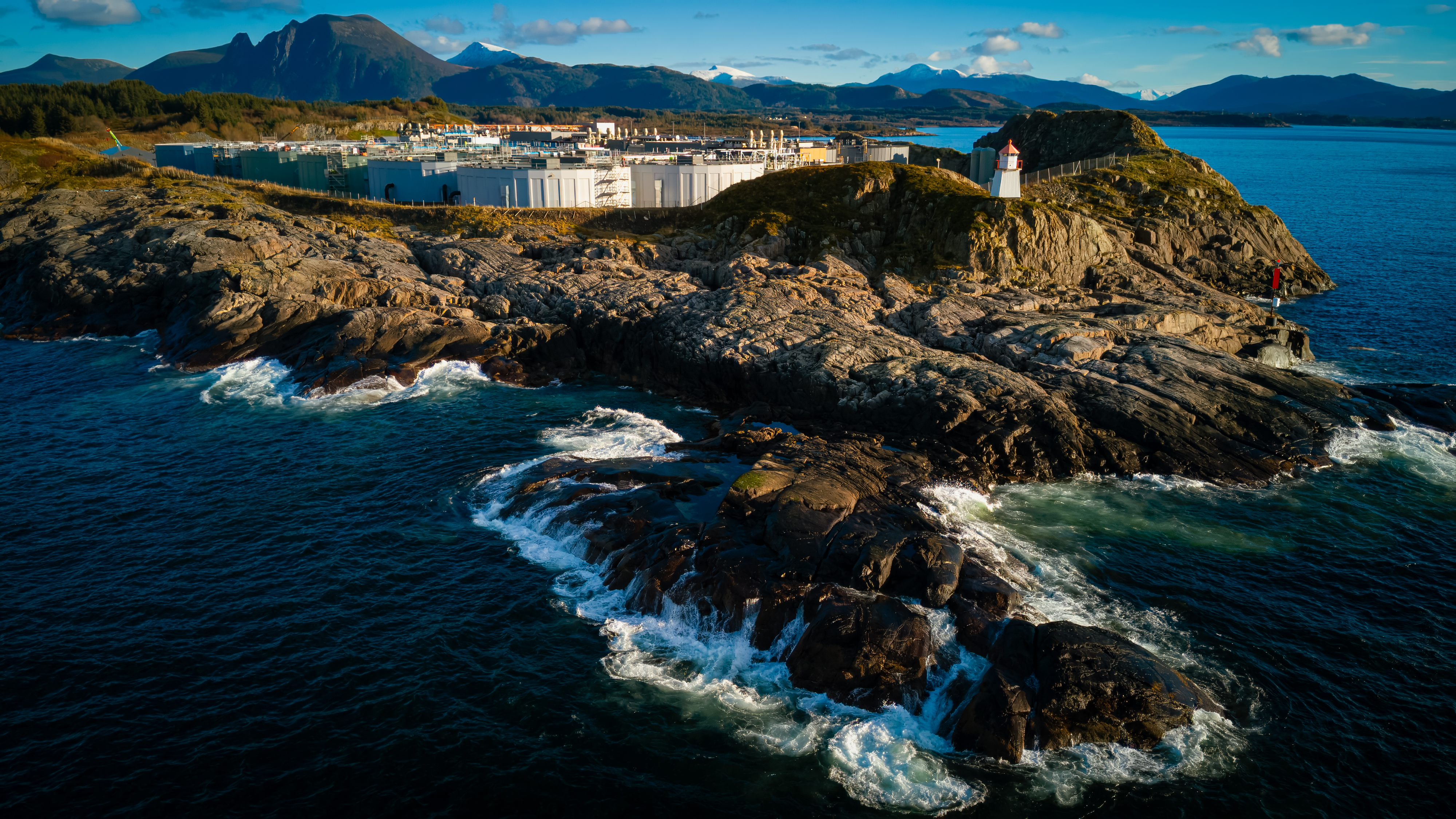
Photo: Drone overview Indre Harøy January 2026
Growth
Indre Harøy phase 2
In land-based salmon farming, Indre Harøy Phase 1 and 2 is a unique platform with strong expected cash flow generation, supporting a significant organic investment capacity for Salmon Evolution in the years ahead.
Phase 2 - including the planned pre-grow out tanks - is expected to add around 10,100 tonnes, increasing Salmon Evolution’s annual harvest capacity from 7,900 tonnes to approximately 18,000 tonnes HOG. An additional 2,200 tonnes HOG beyond the original plan of 7,900 tonnes HOG are achieved by incorporating four pre-grow-out tanks, offering a highly capital-efficient way to scale production using existing infrastructure.
Under the new program the stocking weights in the grow-out department are raised from ~130 grams to ~400 grams, while the targeted harvest weight is reduced to approximately 5.2 kg LW. Combined this shortens the production cycle from approximately 11 months to 8–9 months, making it possible to increase the number of smolt stockings from 6 to 8 per year per phase, improving the utilization of the grow out facility. Generally, this is considered a more conservative production plan with lower average harvest weight and peak densities through the production cycle, also lowering the operational risk through increased robustness and added operational flexibility.
The Phase 2 project (grow out) is divided between Artec Aqua, responsible for process facility design, construction, and commissioning, and HENT, responsible for civil design and construction, in addition to own deliverables. The project builds on the extensive know-how and knowledge gained with Phase 1 and has a total estimated investment cost of up to 2.5 NOKbn, including contingencies, buffers and investments in the pre-grow out tanks.
Indre Harøy growth potential
Project status – Indre Harøy phase 2
The project is progressing as planned, with handover of the first two tanks scheduled for late Q1. Subsequently, Salmon Evolution plans to carry out the first phase 2 smolt release in week 17.
As of date testing and commissioning are well underway. Much of the civil works scope is nearing completion, with the process installations being the core focus in the project going forward. High focus on effective project execution to minimize delays, change orders and ensure good coordination between all disciplines.
The remaining grow out tanks will be gradually completed and taken into operation over the course of 2026, and Salmon Evolution expects to stock around 1.1 million smolt in phase 2 this year, bringing the total 2026 smolt release to around 2.8 million, up from 1.7 million smolt in 2025.
There have been no lost time injuries in the project, a significant milestone in a project of this size and complexity.
At the end of Q4-25 the accumulated investment in the project amounted to 1,579 NOKm, of which 325 NOKm invested during the quarter.
In parallel Salmon Evolution has completed planning and engineering activities for the pre-grow-out tanks, with targeted completion during Q2-27, subject to final investment decision during the first half of 2026.
Photo: Project development Indre Harøy January 2026
Salmon Evolution has recently signed a long-term smolt sourcing agreement with an external supplier. Together with the in-house smolt production at Dale, the Company’s smolt needs for phase 1 and 2 are covered. In parallel, Salmon Evolution is developing a plan to cover future smolt needs, including for phase 3.
Norway expansion
In July 2025 new regulation for land-based aquaculture in Norway was put into law. Salmon Evolution’s grow-out facility at Indre Harøy is already fully compliant with the new requirements.
Consequently, with full regulatory clarity and the most efficient salmon farming value-chain globally - a key enabler for industry cost leadership - Norway and Indre Harøy phase 3 is our top priority for further expansion.
At Indre Harøy including phase 3, Salmon Evolution have all permits in place for up to 36,000 tonnes HOG in annual production. At Indre Harøy there is also additional land regulated for industrial use with a primary focus on establishing aquaculture-related businesses, that could potentially facilitate further expansion outside the communicated 36,000 tonnes HOG. However, this will require Salmon Evolution to purchase the land and secure the necessary permits for such potential expansion.
Salmon Evolution is continuously exploring other possible high-potential expansion sites in Norway, focusing on sites with similar, optimal farming conditions as Indre Harøy.
International expansion
Activity and investments in international expansion projects have been reduced to a minimum, as development of the Indre Harøy site remains Salmon Evolution’s foremost priority.
In North America an extensive site search has been undertaken over the last few years with several high-potential sites identified. In this process Salmon Evolution has focused on areas with an existing salmon farming value chain, mirroring the approach in Norway. Considering the current geopolitical situation and uncertainty with respect to tariffs combined with the expected capex and opex structure, Salmon Evolution has a “wait and see” approach to future expansion in North America.
Update on partnership model in Korea
In January 2026 Salmon Evolution announced an update on the partnership with Dongwon Industries where the parties intend to construct and operate a land-based salmon farm in Korea. The existing joint venture agreement has been replaced with technical advisory agreement, under which Salmon Evolution will provide technical advisory services on market terms, including provisions for potentially significant royalty payments linked to certain operation milestones. Under the new structure, Salmon Evolution has no further investment commitments but remains a minority shareholder with a 49 % ownership which is expected to be diluted over time. As part of the agreement, Salmon Evolution also holds a five-year purchase option for up to 33 % ownership in the project on market terms.
Funding
Since inception, Salmon Evolution has actively utilized debt and capital markets to fund its growth roadmap. The Company continues to optimize its capital structure through strategic financial management, balancing debt and equity to maintain financial stability while supporting expansion projects. By regularly evaluating and adjusting its capital structure, Salmon Evolution aims to minimize financing costs and enhance returns on capital employed, ensuring a strong foundation for long-term value creation.
Development in paid-in equity (NOKm)
Source: Company data
Funding Indre Harøy Phase 1 and 2
In June 2024 Salmon Evolution expanded its existing senior secured debt financing package related to Indre Harøy Phase 1 and 2, from 1,550 NOKm to 2,225 NOKm.
Additionally, Salmon Evolution strengthened its financial flexibility with a new credit facility of up-to 250 NOKm in June 2025. The facility is based on customary market terms and a tenor of 12 months with an option to extend another 6 months subject to lender consent.
The debt funding package consists of the following credit facilities:
- 525 NOKm non-amortizing term loan facility (the “Term loan”).
- 250 NOKm RCF facility available for general corporate purposes including Indre Harøy phase 2 capex (the “RCF facility”)
- 1,225 NOKm construction facility available for financing of capex relating to the phase 2 grow-out facility at Indre Harøy (the “Construction Facility grow-out”).
- 225 NOKm construction facility available for financing of capex relating to the phase 2 additional tank capacity (the “Construction facility additional tank capacity”).
- New 250 NOKm new credit facility dedicated to Indre Harøy and phase 2 investments (the “New facility”).
As per 31 December 2025, the Term Loan of 525 NOKm, the 250 NOKm RCF facility, 105m of the New facility and 752 NOKm of the construction facilities were drawn.
Furthermore, the Company has a 200 NOKm overdraft facility for biomass and receivables financing.
As announced in the Q3-25 presentation, Salmon Evolution has initiated a refinancing of the senior secured debt financing package. The process is proceeding according to plan.
Funding Salmon Evolution Dale
The Company has a debt financing package of 60 NOKm in relation to Salmon Evolution Dale.
The bank debt package is split across three separate facilities and will be used as follows:
- General corporate purposes, hereunder financing of working capital
- Investments relating to facility upgrades
- 25 NOKm in acquisition financing utilized for refinancing of seller’s credit with previous owners
As per 31 December 2025 about 49 NOKm of the 60 NOKm debt financing package was drawn.
Our technology – Hybrid flow-through system (HFS)
The Company use a hybrid flow-through system (HFS) technology, which provides a steady supply of fresh, filtered seawater while reusing approximately 65% of the water. This reusage level represents what the Company considers the “sweet spot,” balancing cost efficiency with operational risk. Higher reuse levels require more extensive filtration and water treatment, increasing the complexity and operational risk. Lower reuse levels will significantly complicate filtration and UV treatment of incoming water, as well as maintaining a stable temperature at the farm.
At the Indre Harøy facility, seawater intake is based on two inlet pipes located at depths of 25 meters and 95 meters. This allows access seawater with optimal temperatures year-round, thus reducing the energy consumption related to heating the water to maintain a stable temperature. The incoming water is filtered and treated with UV to minimize the impact from parasites, viruses and other particles, and eliminate the impact from sea lice, whilst ensuring a continuous flow of fresh, clean seawater.
To maintain optimal biological and growth conditions in the fish tanks, oxygen and CO2 levels are continuously monitored and adjusted. Each tank operates as a separate biological zone, ensuring that water does not mix between tanks. This design serves as a critical risk mitigation measure, as any potential disease outbreak is contained within the affected tank, preventing cross-contamination.
Aligned with our commitment to sustainability and circular economy principles, Salmon Evolution filters wastewater and collects sludge, which is then transported to a recirculation plant for conversion into fertilizer, biogas, or similar products.
Salmon Evolution use data and AI to continuously drive optimization and reduce risk, leveraging the benefits of land-based salmon farming where the goal is to identify and replicate optimal conditions for fish growth. Every day over 40 million data points are logged at Indre Harøy, creating a vast pool of insights, that paired with deep operational expertise and know-how, provide actionable data for real-time decision making.
Making a home for the salmon to thrive